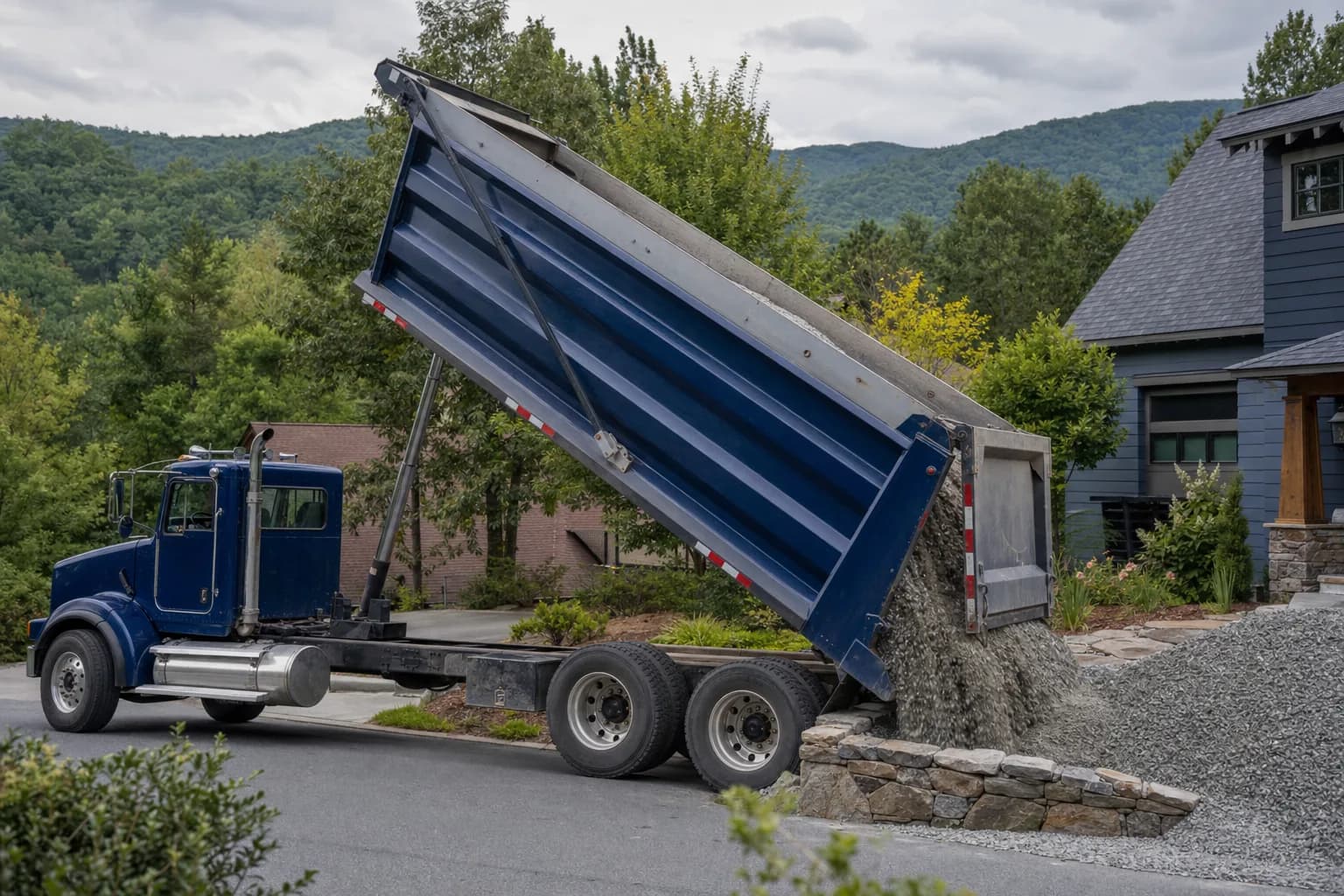
Bulk Material Delivery: Deciding Where the Pile Should Land
By the time most people reach this page the material is settled and one question is left: can a loaded truck get to the spot, and if not, where is the next best place to tip. That decision is worth twenty minutes of walking the property, because bulk material delivery puts the load down once and everything after that is shovel work. On red clay the wrong answer costs more than it would on sand, since a pile parked on the lawn in a wet week leaves ruts that outlast the project.
Where should the load land on a lot that slopes toward the house?
Pick the spot by where the material is going, not by where the truck can most easily stop. Downhill of the work means every wheelbarrow load is uphill, and on a Piedmont lot that usually means uphill through the softest ground on the property.
Mark it clearly. A cone, a flag or a stake the driver can see from the cab is enough, and it removes the guesswork if nobody is standing there. Keep the spot off anything you mind being marked: turf, a septic field, an irrigation line, a freshly poured apron.
Can a loaded truck get down a lane cut through pines and clay?
It needs a clear lane roughly twelve feet wide, with no low limbs and nothing hanging overhead. Height catches people out more often than width, because limbs that a pickup slides under will scrape a raised bed.
The ground matters as much as the geometry. The bed goes up to tip, so the truck needs firm, reasonably level footing at the drop point. Saturated clay after a long wet spell is the classic problem here; sandy Coastal Plain shoulders are the other one, since a wheel drops into soft sand without much warning.
Does somebody have to be home when it arrives?
No. An open route, a marked drop point and a note in the drop-instructions field on the order are enough, and the driver will call or text if the placement is still not obvious. Keep a phone to hand on the day for exactly that reason: the tip itself runs roughly 10 to 15 minutes, so that call is the only window in which anything moves.
At what point is a Carolina address actually settled?
Delivery is arranged at checkout from the ZIP code you enter, and the order is then matched to a supplier in the network near that address. An agent contacts you to confirm the exact delivery address, which is the point at which it is genuinely settled, and the confirmation names the date you chose and a local contact.
Quantity and the delivery date are chosen on the product page before that, from the weekdays offered, with a field for where the load should be dropped. So you reach checkout with the material, the tonnage, the date and the placement note already set, and the current delivery offer for that address is shown there.
Can a base layer and a surface layer arrive together?
Order each product for its own quantity. Run the calculators once per layer, since a compacted base and a surface layer sit at different depths and weigh different amounts per cubic yard, then place them as separate line items. It is worth thinking about the order they are needed in: ABC Stone has to be spread and compacted before #57 Stone or Driveway Gravel goes over the top of it.
What if the truck cannot reach the back of the property?
Say so before ordering rather than on the day. Where the drop point is not reachable, the load goes down at the nearest safe point instead, which may be the end of the drive or the road edge. If the access is marginal, describe the lane, the gate width and the turning space through the contact form with your ZIP code before you order. Everything else about the catalogue sits on the product pages, and changes, shortfalls and the published refund policy are covered in the ordering questions.
Common questions
The apron at the road is freshly poured concrete. Can the truck cross it?
Ask before you order. A cured apron will generally take a loaded axle and a green one will not, and no part of the route is worth a cracked slab. If the concrete is new, nominate a drop that does not cross it even where that means a longer carry, and put the restriction in the drop instructions so it is not a decision made at the gate.
Is there a point in the year when a delivery is more likely to cause trouble?
Not a month so much as a condition. A long wet spell leaves Piedmont clay soft enough that a loaded truck marks the ground and the base underneath cannot be compacted properly anyway. In the western counties a hard freeze does the same in reverse. A few dry days beforehand solve most of it.
Coastal Plain shoulders are sandy here. What should I be looking at?
The edge rather than the middle. Sand gives without much warning under one wheel, and the drop from a firm track into a soft shoulder is often only a few inches wide. Keep the truck to the center of the approach, pick a drop spot with firm ground on both sides of it, and do not rely on the fact that a pickup has used the same edge all year.
The pile will sit on red clay for a few days. Does that cost me anything?
The bottom of it, usually. Material tipped straight onto wet clay picks the clay up as you shovel down into it, and the last few inches of a base load end up as something you would not want in the layer. Put it on the drive if you can, and on plywood or a tarp if you cannot.
Place Your Order
Delivery is free for every order. Look through the product options, calculate the amount needed, then order today.
North Carolina Rock Supply is an America Rocks LLC brand. America Rocks LLC operates this website, is the seller of record for every order placed on it, and is the company our terms and policies refer to as "we", "us" and "our". We sell bulk material online and schedule its delivery; the loads come from independent local quarries and landscape-supply yards, which deliver them by dump truck.
America Rocks LLC, 30 N Gould St, Sheridan, WY 82801 (registered office, not a yard or pickup point) · (919) 752-3797 · sales@northcarolinarocksupply.com