Rip Rap Calculator for Carolina Banks, Shorelines and Outfalls
Enter your project dimensions
Most of the erosion work this rip rap calculator gets used for starts the same way. A tropical system parks over the county, several inches fall on clay that was already wet, and the runoff finds the one place on the property with nothing holding the soil down: a stream bank, a pond edge, the ground below a culvert. Armor stone is the answer, and it is measured and ordered in a way that has almost nothing in common with landscaping rock.
What a tape can measure on a bank and what it cannot
The tonnage this page produces describes a layer of stone on a surface. It knows nothing about whether that surface is ready to receive it. A bank steeper than two horizontal to one vertical is an engineering question rather than a stone question, and no amount of extra rock fixes it. A face without fabric or bedding under it will look fine for a season while the soil washes out from behind the stone. A toe that stops above the scour line will drop the whole installation into the water from the bottom up.
Shape the bank, decide on the bedding, and fix the toe elevation first. Then calculate, because those three decisions change the area you are measuring.
Why 3,100 pounds a cubic yard makes a ton look small
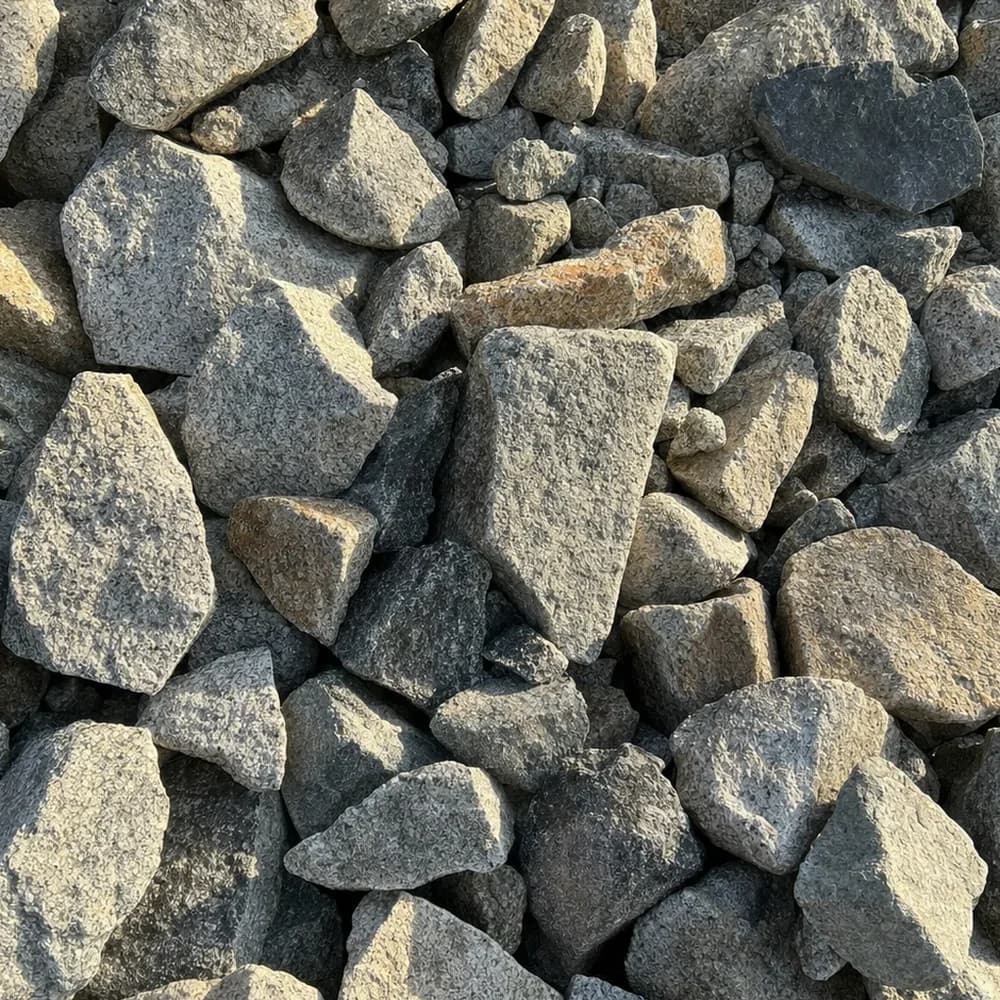
This site publishes riprap at about 3,100 pounds a cubic yard, or 1.55 tons, for stone generally sized four to twelve inches and up. That approximate figure is what the tool applies, and the consequence surprises people: a ton is under two thirds of a cubic yard, about 17 cubic feet, a cube a shade over two and a half feet on a side. Spread at the twelve inch minimum, that ton covers something like 17 square feet, so a hundred square feet of bank takes somewhere near six tons.
Compare that with the landscape materials on this site, where a ton of washed stone at two inches covers well over a hundred square feet against the seventeen above. Same truck, same word, and it is why the delivered pile always looks too small beside the bank it has to cover.
Running a tape down the slope face, not across the map
Measure the distance from the toe to the top of the protected area along the bank itself, following the slope, and multiply that by the length of shoreline or channel being armored. The flat area you would read off a plan is always smaller than the surface you have to cover, and on a steep face it is smaller by a lot.
Layer thickness is one and a half to two times the largest stone in the load, and never under twelve inches. For the four to twelve inch stone most residential banks use, that lands at twelve to eighteen. Larger rock or faster water pushes it to twenty four, which is the ceiling on the depth field, so the tool covers the full residential range without a workaround.
Turning a measured bank into tons in the rip rap calculator
Choose Rectangle for a straight run of bank, Circle for a round feature, or Multiple areas where the slope changes height along its length. Length, width and diameter go in as feet, depth in as inches between 0.25 and 24. Set the material so the weight is right, tick "add 5% extra for compaction & spillage" for the stone that rolls into the water while you are placing, and read cubic yards, tons and cubic feet. "Email my quote" keeps the figures beside your measurements.
60 feet of stream bank, measured on the slope
An illustrative example, not a customer project. The bank runs 60 feet and the tape reads 7 feet from toe to top down the face, so the surface area is 420 square feet. The stone is in the four to twelve inch range, so the layer is 18 inches.
420 x 18 / 12 = 630 cubic feet. 630 / 27 = 23.33 cubic yards. At 1.55 tons a yard that is 36.17 tons of RipRap.
The bedding underneath is its own order. Four inches of #4 Crushed Stone over the same 420 square feet is 420 x 4 / 12 = 140 cubic feet, 5.19 cubic yards, and at 1.45 tons a yard about 7.52 tons. Non-woven geotextile does the same job if you would rather roll fabric than place a second material, though that comes from a landscape supplier rather than this catalogue.
Fabric first, the toe locked, then the apron past the pipe
Set fabric or three to four inches of bedding stone on the shaped soil before any armor goes down. Start at the bottom and set the lowest course below the waterline or the expected scour depth, because bank failures begin at the toe and work upward. Place the exposed top course by machine or by hand so the stones nest into one another rather than sitting wherever they landed off the bucket.
Before that lowest course goes in below the ordinary high water line of a stream, pond or sound-side shoreline, check what your state and local authorities require. Work in and along water is commonly permitted work, and the answer depends on the waterbody rather than on the size of the repair.
Below a culvert, carry the apron four to six pipe diameters downstream. That is where the discharge is still concentrated enough to cut, and it is the stretch people routinely stop short of.
Four to eight inch stone, or eight to twelve
Size follows water force. Four to eight inch riprap suits pond banks, downspout outfalls and slow-moving streams. Eight to twelve is for lake shores taking boat wake and for channels that move quickly when a storm system passes through. Highway and spillway work runs to its own engineered classes and depths, so build those from the drawing rather than from this page.
Where you are between two sizes, take the larger stone and the deeper layer. Weight is the only thing holding it in place. None of this is the same errand as a decorative bank of Large River Rock, which is sized in the river rock calculator and is chosen for how it looks in a dry creek line rather than for what it can resist. The washed sizes a drainage job needs alongside the armor belong in the stone calculator.
Ordering long, and the walk you take after the first big storm
Round up and keep reserve stone on site, because the repairs this work needs are small and occasional rather than scheduled. When the water drops after a storm, walk the bank and look for displaced toe stone, soil showing between rocks, or fabric visible anywhere. Reset what has shifted, fill the shallow patches from the reserve, and check the outfall apron for cutting. Ten minutes twice a year is the whole maintenance program.
Check the route before the load arrives: the last stretch down to a pond is where a loaded truck sinks into wet clay, and stone moved twice costs you the afternoon. Delivery is arranged at checkout by ZIP code, and the truck needs clear access to a spot where the pile can be dumped, which is worth reading up on under delivery and site access. Take the tonnage to the product page to choose a quantity and a date, and order the bedding stone on the same visit. If you are unsure which size class the water on your property justifies, describe the bank you are repairing, and if the job runs to three materials, every material calculator sits on one page.
Common questions
The panel gives me a yardage as well as a tonnage. Which one do I order against?
Cubic yards describe the space the layer occupies, which is what your measurements produced. Tons describe what comes off the truck, and the conversion runs through the published weight of 3,100 pounds a cubic yard. Order in tons, sanity-check in yards.
Is the depth I enter the loose layer or the compacted one?
The finished layer as it sits. Riprap is placed and nested rather than rolled, so it does not lose height the way a base course does. What it does lose is a stone or two rolling into the water, which is what the five percent tick box is there for.
How do I calculate a round feature, such as an apron below a pipe?
Use Circle mode and enter the diameter across the middle. A twelve foot apron at twelve inches is 3.1416 x 6 x 6 = 113 square feet, 113 cubic feet, 4.19 cubic yards, and about 6.49 tons. The same method covers a circular splash pad or a ring of stone round a structure.
Can I check the answer without a calculator?
Roughly. At the twelve inch minimum a ton covers about 17 square feet, so divide your slope-face area by 17 and you are close. At eighteen inches use 12 square feet a ton, and at twenty four use 9. If your hand figure and the screen figure disagree by more than a ton or two, one of the measurements is wrong.
My neighbor got far fewer tons for a bank the same length. Why?
Layer depth and stone weight, almost always. Armor stone at 3,100 pounds a cubic yard laid eighteen inches deep is a different order of magnitude from washed stone at 2,800 pounds laid two inches, and a slope face measured properly is longer than the same bank measured across the top.
Related calculators
Banks don't armor themselves.
RipRap by the ton with free delivery, plus the #4 bedding stone to go under it.