Large River Rock for North Carolina Splash Aprons, Outfalls and Pond Edges
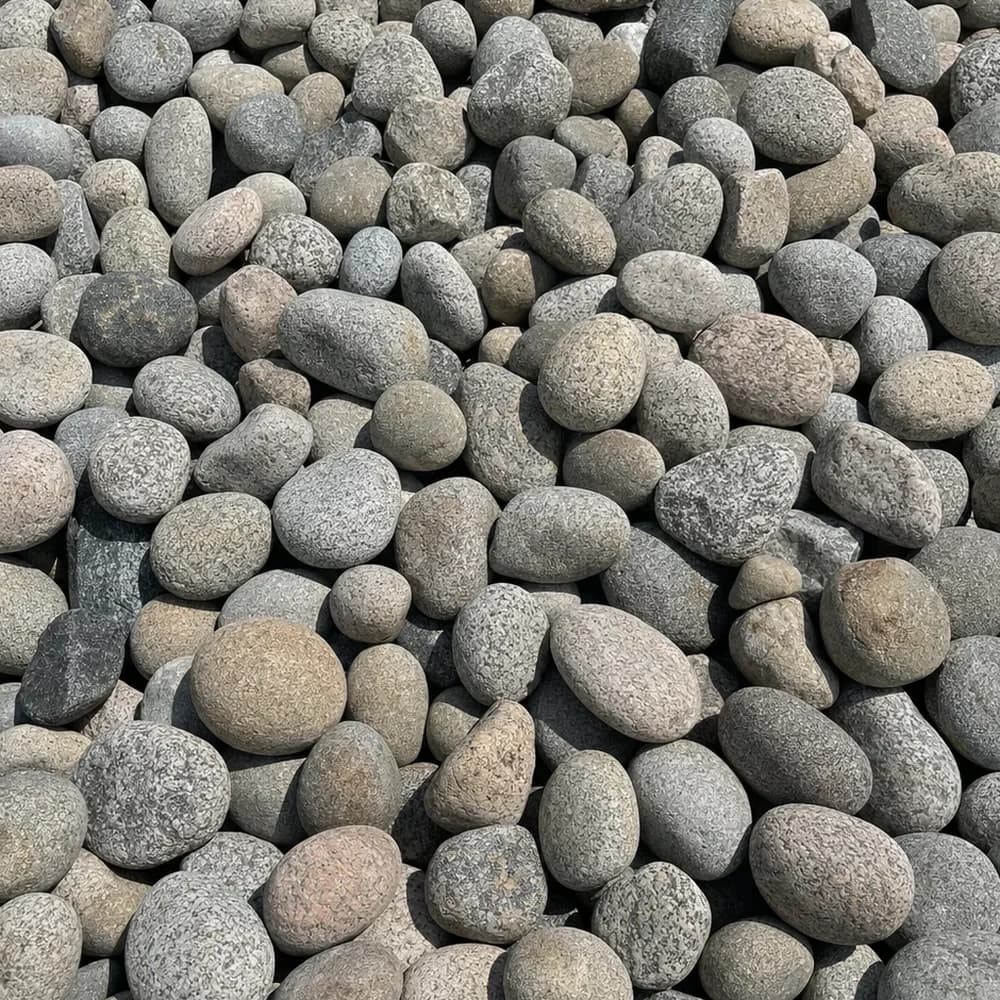
For a North Carolina yard with red-clay runoff or a plain planting bed, Large River Rock creates a dry creek or water-feature edge with lasting visual weight.
- Size: 2 inches to 4 inches
- Type: Smooth, naturally rounded stones
- Color: Tans, grays and browns
From $1,114 for 1 ton, delivery included
Larger loads cost less per ton: 500 tons is $99,270 ($198.54 per ton). Pick any quantity below for a delivered price.
Free delivery included
Free delivery anywhere in North Carolina
Pick a delivery date
Weekday delivery, earliest Oct 20
Get a Free Quote
Fill out the form and our sales team will get back to you within the hour.
Size and Grading
- Size
- 2 inches to 4 inches
- Type
- Smooth, naturally rounded stones
- Color
- Tans, grays and browns
The job this size gets bought for, more than any other in this state, is a spot that has already been fixed two or three times with something smaller. Mulch under a downspout that leaves in the first storm band of the summer. Pea gravel at a pipe outfall that ends up spread across the lawn. A bed edge on a clay slope that washes into the driveway every autumn. Large river rock is what gets ordered once the owner accepts that the problem is not the material's appearance, it is its weight.
| Spec | What is listed |
|---|---|
| Size | 2 inches to 4 inches |
| Type | Smooth, naturally rounded stones |
| Color | Tans, grays and browns |
The downspout corner that scours out twice a summer
Piedmont clay does not absorb a downpour, it sheds it, and a downspout concentrates a whole roof plane into a single point on that clay. What forms is a scour hole, then a channel leaving it, then a fan of whatever material used to be in the bed. Heavy rainfall and the remnants of tropical systems make short work of anything light.
A splash apron built from 2 to 4 inch rounded stone survives that because each piece is heavy enough that the flow cannot lift it. The rounded shape, which is a liability on a path or a drive, is an asset here: water slides over and between the stones rather than catching on fractured faces, so the apron breaks the fall of the water and spreads it out instead of concentrating it further.
The same reasoning covers a pipe outfall, the low point of a swale, and the invert and outside bends of a dry creek bed where the flow crowds hardest.
How 2 to 4 inch rounded stone sits on a red clay slope
Weight is only half of it. The other half is what is underneath.
Rounded stone set straight onto bare clay slowly disappears into it. Every wet spell softens the clay, the stones press in, and after two or three seasons half the apron is buried and the surface is mud again. Fabric between clay and stone prevents that, and on a slope it also keeps the soil face from washing out from under the bottom edge.
Grade matters too. On anything with a real fall, rounded stone wants a toe: a buried timber, a set edge, or a row of the largest pieces bedded into a shallow trench across the low end. Build that first and lay the field above it. Coastal Plain sand behaves differently again, taking water away readily but offering nothing to hold the stone in place, so an edge restraint matters more there than depth does.
Building a splash apron out from the scour hole
Start by filling the hole rather than covering it. A scour hollow left under an apron is a void that concentrates flow under the stone, so bring it back to grade with compacted material first and shape a shallow dish where the water will land.
Lay fabric next, running it wider than the finished stone so the edges can be tucked. Set the largest stones at the point of impact and along the outside of any bend, then work outward with the rest. This is placed work: stones seated so they bear on each other rather than tipped out and raked flat. Finish slightly below the surrounding grade so runoff enters the apron instead of skirting around it.
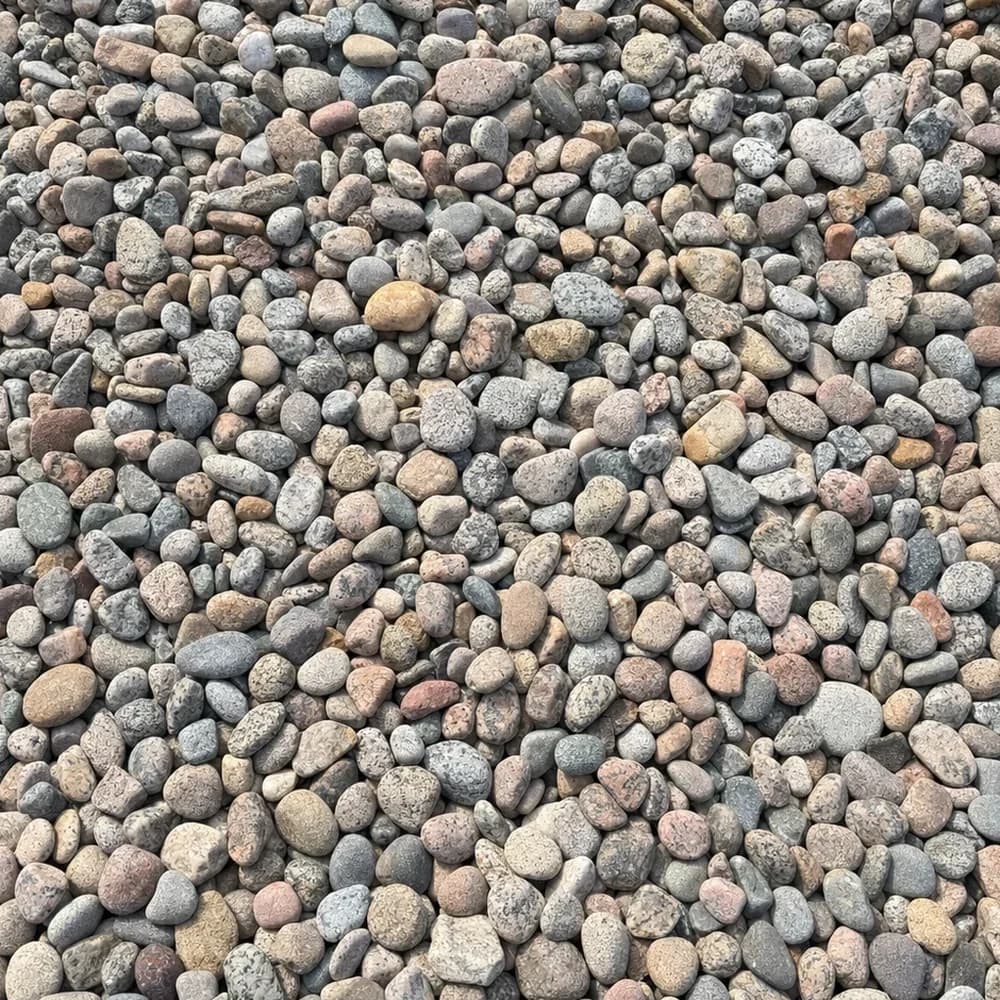
Where a dry creek bed runs on from the apron, this size belongs in the invert and at the bends, with the standard River Rock filling the field around it. That two-size approach is what makes a channel look like a channel rather than a strip of gravel.
Pond edges, shoreline and what a tropical system leaves behind
Around a pond or a water feature, the job is blending a constructed edge into the ground around it. Rounded stone at this scale reads as natural at the waterline and is heavy enough to stay where it was placed when the level rises. Set the stones into the bank rather than stacking them on it, keeping the line irregular so it does not read as a border.
On a stream bank or a shoreline after storm damage, this size is the limit rather than the answer. It will hold a gentle edge and a low-energy face. Once the flow is strong enough to move 4 inch stone, the material for the job is RipRap, which is a much larger angular armor stone placed to interlock. Rounded pieces cannot interlock, and that is the ceiling on what this listing can hold.
Wall backfill is the one job on this page it should not take
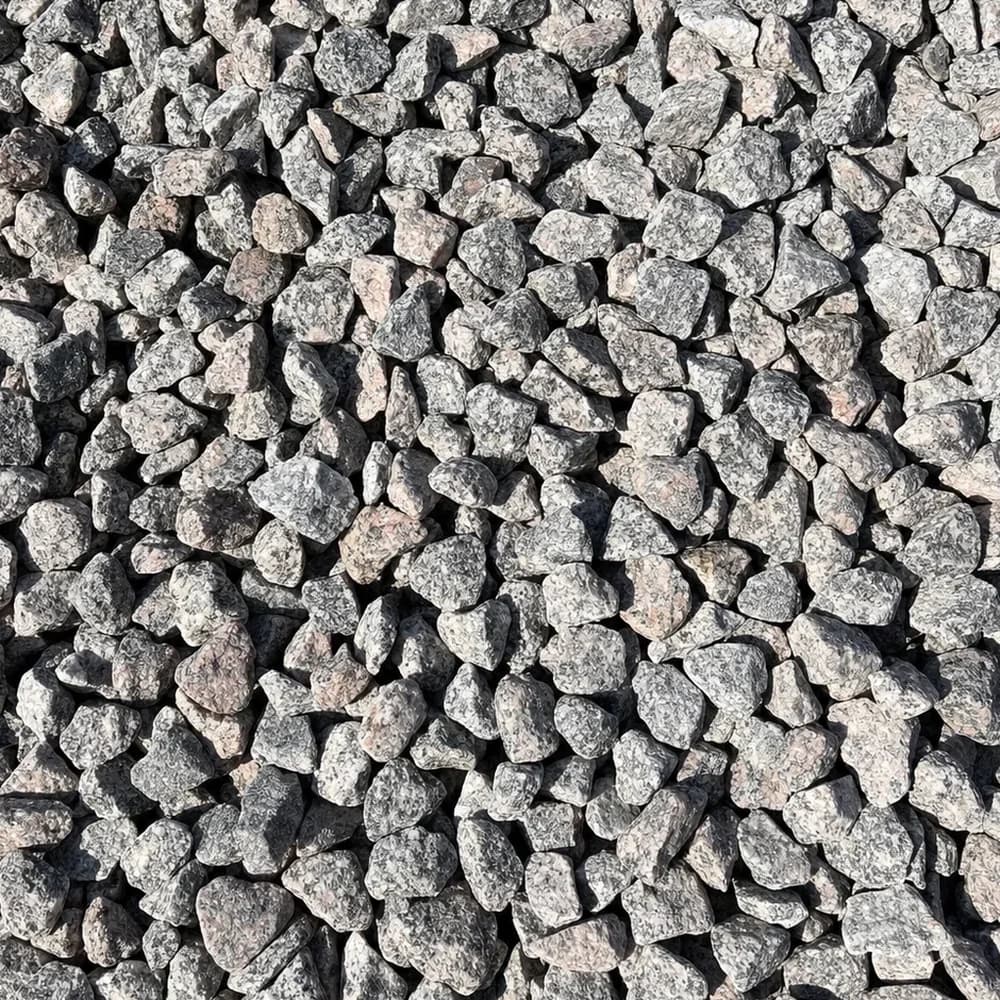
The stone behind a retaining wall has to do two things: stay open so water reaches the drain, and hold its arrangement while soil and surcharge press on it. Angular stone does both, because fractured faces lock against each other under load. Rounded 2 to 4 inch stone does neither well. It rolls into a denser packing under pressure, bridges over the pipe leaving hollows, and is too coarse to work into the zone right behind the units. Drain Rock in the angular variety is the listing for that job.
Sediment, leaves and the one job a year
An apron built from this size needs very little, but it is not maintenance-free. The voids between 2 to 4 inch stones are large, and everything a storm carries ends up in them: leaf litter, pine straw, silt off a bare slope upstream. Left alone, that fills the spaces and turns a drainage feature into a planted one.
The annual job is a blower or a stiff rake through the stone before winter, and a hose on anything silted. Stones that have moved get put back, a ten-minute task yearly and a rebuild if left for five. Fix the source where you can, since silt off a bare slope above keeps coming.
Tons for a 6 by 10 apron and a 30-foot pond edge
Two hypothetical areas. Tonnage uses this site's published weight for river rock, about 2,700 lb per cubic yard or 1.35 tons per yard. That row is listed for the 1 to 3 inch grade, so treat it as the closest approximate figure for this larger size.
A splash apron, 6 feet by 10 feet, at 5 inches deep:
- Area: 6 x 10 = 60 square feet
- Depth: 5 / 12 = 0.417 feet
- Volume: 60 x 0.417 = 25 cubic feet
- Cubic yards: 25 / 27 = 0.93
- Tons: 0.93 x 1.35 = 1.3
A pond edge, 30 feet long and averaging 3 feet wide, also at 5 inches:
- Area: 30 x 3 = 90 square feet
- Depth: 5 / 12 = 0.417 feet
- Volume: 90 x 0.417 = 37.5 cubic feet
- Cubic yards: 37.5 / 27 = 1.39
- Tons: 1.39 x 1.35 = 1.9
Around 2.3 cubic yards and 3.2 tons for the pair. The river rock tonnage tool will take both areas in one pass and adds an extra allowance by default, which is worth keeping on a dished apron since the profile holds more than a flat rectangle of the same footprint. Pick the tonnage and a delivery date on this listing; delivery is arranged at checkout from the ZIP code you enter, and a drop close to the work saves a long wheelbarrow, because stone this size is carried by hand a few pieces at a time.
Quickly Calculate How Much You Need
Material: Large River Rock
How to Measure
Measure the length and width of your project area in feet
Decide on depth in inches (2" for landscaping, 4" for driveways)
Enter the values above and we'll calculate the tonnage you need
Need help figuring out the right amount? We can help!
Call or text us at (919) 752-3797 and we'll help you calculate the right quantity for your project.
Not sure how much you need? The River Rock Calculator has depth guides, coverage charts and worked examples for this material.
Frequently Asked Questions About Large River Rock
Large River Rock delivery across North Carolina
- Charlotte
- Raleigh
- Greensboro
- Durham
- Winston Salem
- Fayetteville
- Cary
- Wilmington
- High Point
- Concord
- Greenville
- Asheville