Crusher Run Calculator for a Carolina Lane, Pad or Turnaround
Enter your project dimensions
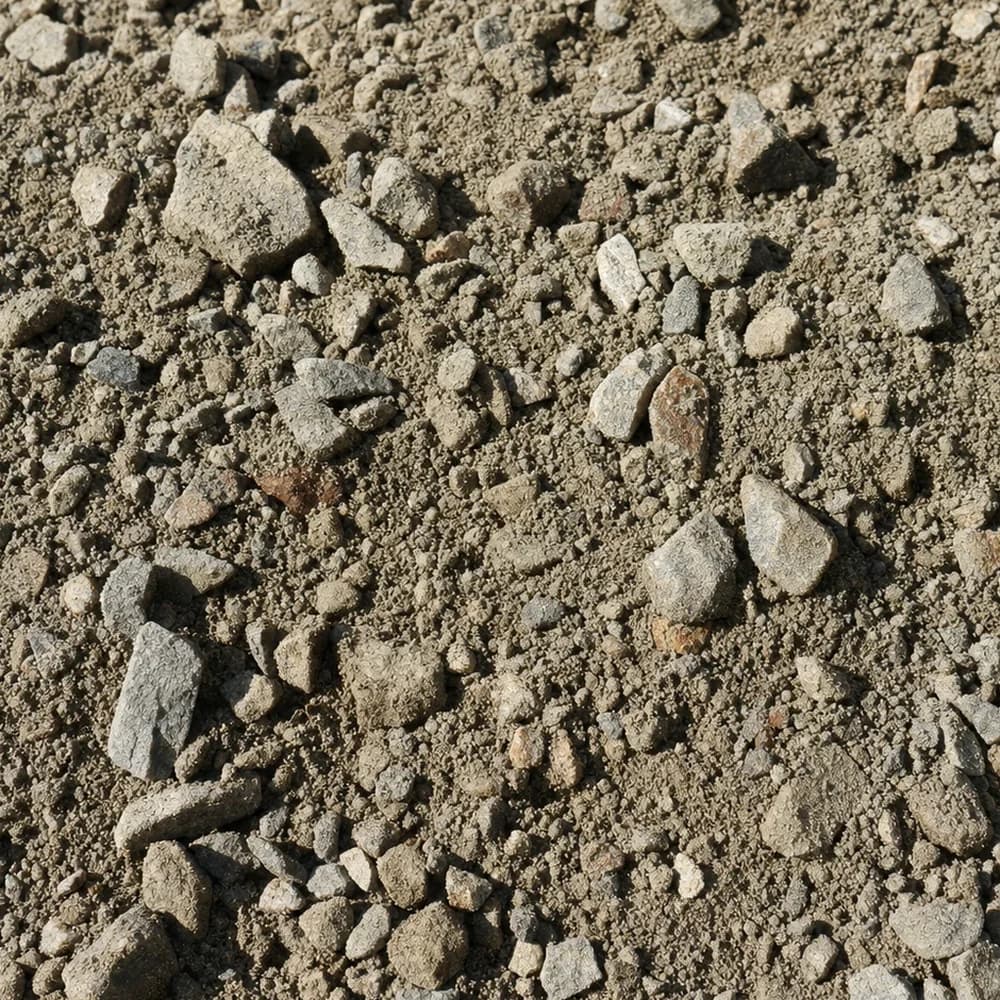
What holds a Piedmont lane together is the dust in it. Crush and run comes with the fines still mixed through the stone, and those fines are what let a roller knit the layer into something a loaded truck can turn on. Washed stone has had them screened out, which is why it drains and why it will never lock up the same way. That one difference decides which product goes under your tires, and it also moves the number this crusher run calculator hands back, because a yard of stone with the fines left in weighs more than a yard of the same stone washed clean.
Choosing between a layer that binds and a layer that drains
The same family is listed here twice, as Crush and Run and as ABC Stone, which is the name almost every contractor in this state uses for aggregate base course. Both carry fines and both compact. Open the road base calculator when the name on your notes is ABC Stone, and this page when it is crush and run, because the name on the ticket is what has to match what turns up on the lane.
What neither belongs in is a drain. The fines that make the layer bind also hold water, so a French drain, a downspout run or a trench behind a wall wants #57 stone or drain rock with the fines washed out. Those sizes are handled by the stone calculator.
Walking the lane with a tape before anything is ordered
Take the running length and the usable width in feet, and write the awkward numbers as decimals, so a lane that scales eleven feet six inches goes down as 11.5. A turnaround or a round pad is measured straight across the middle instead. If the lane widens at the gate, resist averaging it into one rectangle. The tool accepts up to five separate areas, so give the wide part its own entry and let the arithmetic handle it.
Setting a finished depth that survives a loaded truck
Depth on this page means the layer after it has been rolled, not the loose pile off the tailgate. Crush and run loses somewhere between a tenth and a seventh of its height under a plate compactor, so a layer placed at the number you wanted finishes short of it.
Four compacted inches is enough under a path or a paver assembly. Four to six carries everyday cars on a residential drive. Six to eight is the range once a delivery truck, a loaded trailer or a tractor is turning on it. Red clay that stays greasy for days after a wet spell argues for the upper figure in each pair, because a thin base pressed into soft subgrade quietly disappears into it.
Feeding the lane measurements into the crusher run calculator
Pick Rectangle, Circle or Multiple areas at the top of the page. Length and width go in as feet, a turnaround goes in as a diameter in feet, and the depth box takes inches anywhere from 0.25 to 24. Set the material so the weight matches what you are actually buying, leave "add 10% extra for compaction & spillage" ticked, then calculate. The answer comes back three ways, in cubic yards, tons and cubic feet, and "Email my quote" sends you a copy to keep beside your measurements.
Run it once per layer. A base course and a driving layer are different materials at different depths, and a single pass cannot answer for both.
A 45-foot lane running back to a gate
An illustrative example, not a customer job. The lane measures 45 feet by 11 feet, and the plan is five compacted inches of ABC stone over clay.
45 x 11 = 495 square feet. 495 x 5 / 12 = 206.25 cubic feet. 206.25 / 27 = 7.64 cubic yards. At 1.50 tons per yard that is 11.46 tons, or 12.61 tons with the ten percent ticked. Thirteen tons covers it.
The 22-foot turnaround at the top of the same drive
Vehicles swing round at the top, so that circle gets six inches rather than five. A 22-foot diameter gives 3.1416 x 11 x 11 = 380 square feet. At six inches, 380 x 6 / 12 = 190 cubic feet, which is 7.04 cubic yards and 10.56 tons, or 11.62 with the allowance. The circle covers less ground than the lane and still asks for almost as much stone, because the extra inch of depth outweighs the missing square footage.
Spreading in lifts and rolling each one before the next
Start tipping at the far end of the run and work back toward the truck, so you are never wheelbarrowing across finished base. Spread in lifts of roughly two inches and compact each one before the next goes down. Two rolled two-inch lifts outlast one loose four-inch pour by years. Mist each lift lightly first, since crush and run tightens far better damp than dry. Shape the finished surface so water leaves sideways rather than standing in a wheel track, and hold back a wheelbarrow-load for the soft spots that show themselves a week later.
Delivery is arranged at checkout by ZIP code, and the truck needs clear access to the spot where the pile is going.
Why crush and run is quoted at 1.50 tons a cubic yard
The tool multiplies length by width by depth in inches, divides by 12 to reach cubic feet and by 27 to reach cubic yards, then applies the published weight for the material you selected. Crush and run and ABC stone sit at about 3,000 pounds a cubic yard, which is 1.50 tons. The washed sizes, #57 and #67 and 3/4 inch, sit near 2,800 pounds, or 1.40. Screenings come in around 2,900 pounds, or 1.45. All of those are approximate, and all of them are figures this site publishes rather than ones invented for an example.
So the identical hole filled with base material and filled with washed stone gives you two different tickets. The space is the same; what rolls off the truck is not. Take the tonnage to the product page for the material you calculated, choose a quantity and a date there, and repeat for the driving layer if the job has one. If you are unsure whether your subgrade wants six inches or eight, describe what will be driving on it through the contact page.
Common questions
Can one calculation cover both the base and the stone that goes on top?
No. Calculate the base at its compacted depth with crush and run selected, then calculate the driving layer on its own at two to three inches with #57 or driveway gravel selected. The two results are different materials at different weights, so they are ordered as two products rather than added together.
My lane curves and then widens at the gate. How do I measure that?
Break it into pieces that do not overlap and use Multiple areas. A curve is close enough to a rectangle taken along its center line at an average width, and the apron at the gate is its own rectangle. Five areas go in at once and the tool totals them for you.
The existing lane only needs topping up. What depth do I enter?
The depth of the new material, not the depth of the whole lane. Lay a straight board across the worst ruts to see how deep they really run, average that across the length instead of using the deepest point, and calculate the average. Two inches over a tired lane is a common answer.
What happens if the delivery ends up a ton light?
You finish thin at the far end, which is the end you look at every time you come home. Bulk material is bought by the ton, so round the answer up to the next whole ton and leave the ten percent box ticked to cover spillage and the soft patches the tape never found.
How close to the truth is the number on the screen?
The arithmetic is exact for what you type in. What it cannot see is a subgrade that swallows the first lift, a lane wider at one end than the spot you measured, or material lost off the wheelbarrow. Measure in more than one place, enter compacted depth rather than loose depth, and treat the result as the least you should order.
Related calculators
Base tonnage sorted? Good.
Crusher run by the ton, the cheapest structure on the yard, delivered free.